
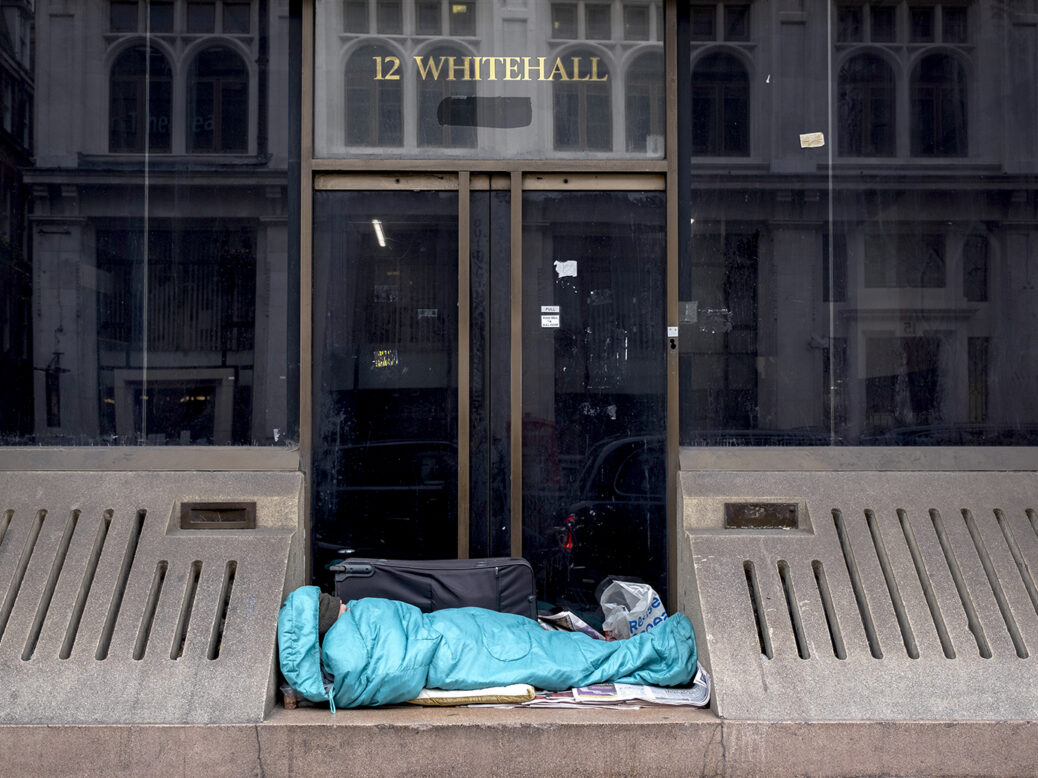
Outside Marks & Spencer’s flagship store on Oxford Street, the shopfronts depicting crisp apples and butter-drenched sourdough contrast with a less lavish sight. Mats and grubby duvets are strewn where people sleeping rough find shelter overnight. It is thought they have been moved on from nearby encampments around Park Lane, another smart central London address, renowned as the second most expensive spot on the Monopoly board – and a homelessness hotspot. Victoria, the Strand, Piccadilly, Soho: for so many, the West End doesn’t mean a glamorous night out but a night on the streets. Welcome to the other Westminster.
Westminster has by far the highest number of rough sleepers in England. At the last yearly count, 2,583 people were found to be sleeping rough there – more than double that of the country’s second-highest-ranking borough of Camden (974 rough sleepers in 2025-26), also in the capital.
There are many reasons for this. Westminster’s central London location and transport links mean people from across the country and around the world tend to congregate there. Public squares, underpasses, the shelter of great landmarks, spacious high streets and theatreland all play a part. Busy day and night, Westminster is also considered a relatively safer place to bed down.
“There’s an anonymity here,” says Paul Grieve, an outreach worker at the Connection at St Martin’s homeless charity, who approaches people on these streets every day. “They don’t want to rough sleep around their local area because maybe they have family members and children around there, whereas in the West End, people are so caught up in their busy day-to-day lives that there’s a real anonymity.”

With its evident wealth, Westminster teases the dream of employment, which for some ends up looking more like begging, busking, selling flowers, or being exploited by pickpocketing and shoplifting gangs. Seasonal waves of Roma migrants from Romania have become a significant feature of central London homelessness. A recent internal analysis by Westminster Council officials I’ve obtained notes a 7 per cent increase from January to March this year, “primarily due to an increase in EEA [European Economic Area] clients”, of whom there was a 41 per cent rise as spring arrived. This has become a preoccupation of the right-wing press, which reports on “professional beggars” in “London’s most affluent area”.
The jarring image of desperate and dispossessed people scattered across England’s commercial and political centre is not lost on those who sleep rough here. When police began clearing rough sleepers out of Westminster Underground Station – where there is an entrance to parliament for MPs, peers and their staff – some of the men who were moved on told me they felt “ignored” each day by politicians with the power to change policy to help them. “They turn a blind eye.”
It’s not lost on Andy Burnham either, who, first thing in the morning on the day he became Prime Minister, went to chop vegetables at the Passage, a homeless centre in Westminster, where he met people who had been on the streets. The scene was set for his first policy announcement going into No 10: to eradicate rough sleeping.
This is the same pledge he made when he became mayor of Greater Manchester in 2017. There, he launched an emergency accommodation scheme, “A Bed Every Night”, and the “Housing First” model, which focuses on finding people a stable home before addressing the issues that have led to their homelessness. Numbers of rough sleepers plummeted in the first four years of his mayoralty, before ticking up again, in line with the national trend.
Burnham’s government will start by spending £340m to provide 1,200 homes and “intensive support” to at least 3,000 people, giving local leaders the power to deliver the programme – effectively a scale-up of Housing First.
But a pledge like this raises all sorts of political questions, especially regarding “no recourse to public funds”, a condition that bans asylum seekers and migrants without settled status from claiming benefits or living in council houses. This is a significant cause of hardship and rough sleeping, to the extent that Burnham has in the past called for an end to the policy (a position he has since dropped). The closure of asylum hotels is contributing to more visible destitution on Britain’s streets.
The main challenge, though, as one former leading civil servant on the policy in the New Labour years tells me, is that NHS and other support services today are in a much worse state than they were when the party began tackling rough sleeping nearly 30 years ago. “Homelessness isn’t a lack of housing – it’s a symptom of relationship breakdown primarily, and subsequent compounding issues like addiction and poor mental health.” In other words, people will always experience pain and lead chaotic lives in any society; it’s just “how long you’re left to suffer on a pavement and what help there is that matters”.
This isn’t impossible. When New Labour set its target to bring rough sleeping down by two thirds in 1999, it achieved it in just two years, a year ahead of target. A great deal of energy was focused on London, where rates were, and still are, highest. It is perhaps an irony that the route to success for the great devolution champion’s flagship policy runs through Westminster.
[Further reading: Labour’s lead may not last]
Content from our partners



Related

This article appears in the 29 Jul 2026 issue of the New Statesman, The new terror
Join the debate
Subscribe here to comment